|
Peru / Inca Trail
July, 2002
|
(Note, I had camera issues, so no
pictures are available at this point in the trip until I arrive in Cusco.
Sorry)
In April of 2002 I found
myself in a Vancouver restaurant with my friend Jenn (who hails from Ontario)
as well as two of her girlfriends, Alison and Mel. As the four of us sat
around chit-chatting about various things, the topic of a summer vacation
arose. Jenn and her friends were talking about going to Peru to hike the
Inca trail and wanted to know if I’d be interested in joining them.
Hmm, let’s think about this for a moment or two. Three women were
asking me if I wanted to go on a trip with them. To South America. To
hike the Inca Trail. Gesh, as no-brainer questions go, this one ranks
right up there! And so, during the second week of July, I found myself
on a plane bound for Lima.
Part 1 –
Flight to Lima
Due to different time
lines and living locations, none of us actually traveled to Peru together.
Alison and Mel arrived a week ahead of Jen and I, and the two of them
had gone off to Lake Titikaka and points beyond. Jenn was flying in to
Lima from someplace in the US and would be waiting for me at Lima International
Airport.
However there are no direct flights from YVR to South America. So, after
a quick stop over at LAX I was on a plane bound for Lima. An interesting
note is that my stop over at LAX was after Sept. 11, 2001. I was worried
that with the paranoia of the US my stop over at LAX would be a nightmare.
However I am pleased to report that after a quick stop with customs to
check my Visa, I was on my way without incident.
I do not recall what the total flying time to Lima was, but something
in the area of 9 or 10 hours sounds about right.
I arrived in Lima at 2am (their time) where I was met by Jenn. Alison
had provided us with the name of a hostel in Lima to stay at for the evening,
so the greatest challenge facing Jenn and I was finding a taxi which would
take us to our hostel. And it is at this point that I should let you know
that neither of us spoke any Spanish!
Pushing our way through the crowds, as there are hoards of people at
the Lima airport wanting to sell you everything from hotel stays to taxi
rides, Jenn and I located a taxi driver who spoke enough English to understand
where we wanted to go.
This was my first experience outside of the North American safety net,
and I was anxious to see whatever I could of Lima. However due to the
time (2am) the entire city was shrouded in a cloud of darkness. Oh well,
my site-seeing would have to wait another day, as Jenn and I were scheduled
to get on a plane the very next morning and fly in to Cusco where we’d
meet up with our friends.
Part 2 – Flight to Cusco
After a fruitful night of sleep, in which I spent more time thinking what the city and culture of Lima would be like than actually sleeping, Jenn and I were in another taxi en-route back to the airport. I’d like to say that I had a good look at the city as we drove to the airport, but our taxi driver took us via some back routes, so I didn’t really get a chance to look at the architecture and surrounding area. I did however generate some impression of Lima and they can be summarized into one word – unimpressed.
Lima appears to be a busy city in a developing country that is struggling with increased numbers of people and a lack of infrastructure to adequately deal with them. I’m sure there are some interesting parts to Lima, although I failed to see them both on our way to the airport, and once we were back in Lima en-route to Canada after finishing up the Inca Trail.
Regardless, after a quick airplane flight from Lima to Cusco we were greeted at the airport by our friends and the process of acclimatization began.
|
|
Jenn and I flying to Cusco |
Welcome to Cusco! |
Part 3 - Cusco
Our game plan was to spend two days in Cusco acclimatizing to the increase in altitude and then head out on the trail on the third day. The Lonely Planet guide that Alison had brought with her proved to be a valuable resource, as it suggested many different ways for us to spend our time. First on our list – the market!
 The first impression I had of the market - whoa! I'd never seen anything like this before and the hustle and bustle was quite exciting. My second impression - this is very different from anything I've experienced before. The first impression I had of the market - whoa! I'd never seen anything like this before and the hustle and bustle was quite exciting. My second impression - this is very different from anything I've experienced before. 
But what stood out the most, at least in my mind, were the vibrant colours found at the market. The blankets, ponchos, and rugs were all made of brightly coloured materials. Contrasted against the usual clothes and materials I was used to seeing in Canada, I found the bright colours a pleasing contrast.
|
|
We didn't purchase any food at the market, but there certainly was a lot of variety |
We spent the better part of the day in the market, before heading back to the city centre. There, we contacted various tour companies and learned that to hike the Inca Trail you have to do it in guided groups of 16. Prior to this, we had been under the impression that we could hike the trail on our own without guides. Nonetheless, we managed to find a tour company with a reasonable price and the four of us signed on.
 The next day, one day prior to our beginning the Inca Trail, we purchased a park pass which enabled us to visit many of the historic The next day, one day prior to our beginning the Inca Trail, we purchased a park pass which enabled us to visit many of the historic  sites in and around the area. I highly recommend the pass and they can usually be purchased from any of the local tourist shops. We were fortunate enough to have a cab driver who not only knew the location of many of the historic places, but was also kind enough to give us a mini walking tour of each site. This was a DEFINITE advantage because none of the sites have any form of self-guided tours or information placards. sites in and around the area. I highly recommend the pass and they can usually be purchased from any of the local tourist shops. We were fortunate enough to have a cab driver who not only knew the location of many of the historic places, but was also kind enough to give us a mini walking tour of each site. This was a DEFINITE advantage because none of the sites have any form of self-guided tours or information placards.
 The downside though...The weather had turned nasty by the time we hit the third area (there are 10 areas or so in and around Cusco) and we had to cut our day short. The downside though...The weather had turned nasty by the time we hit the third area (there are 10 areas or so in and around Cusco) and we had to cut our day short.
After two days of acclimatizing to the change in altitude, we were ready to take on the Inca trail.
The city squre in Cusco |
|
A local parade that was taking place by the school children happened while we were in Cusco. The picture does not do the brigh colours justice. |
|
Part 4 – The Inca Trail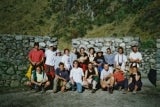
A bus ride takes you out of the City of Cusco to the trail head. Here, you sign in at the booth, meet up with the rest of your tour group, and begin your hike.
Sitting here, writing this trip report over two years later, I'm unable to recall the name of the tour company we went with. I think that the price of our hike was $175USD, but I'm not 100% sure of that. I do know that the price of our hike included porters who carried our tents and all our food. As an individual hiker, we were responsible for carrying our thermarests, sleeping bags, and any changes of clothing we wanted.
However we did not know all of this when we planned the hike from Canada, so the four of us brought our own sleeping bags, tents, and thermarests with us. Which was probably good thing, because the thermarests provided by the hiking company were not thermarests at all, but rather just blue foam sleeping pads. The tents were standard two person dome tents, and from what everyone was saying, the tents were ok but nothing special.
 So what were the views like and hike like? Well as I live in BC, the mountain views I'm used to differed from what we encountered in Peru. The Peruvian mountain views however were nonetheless spectacular. So what were the views like and hike like? Well as I live in BC, the mountain views I'm used to differed from what we encountered in Peru. The Peruvian mountain views however were nonetheless spectacular.
The end goal of the Inca Trail is of course Macchu Pichu. And how was the trail/hike in to our final destination? Overall the hike/trail is wide track and easily marked/visible.
|
| Our guide talks to us at one of
the many ruins along the way |
There is absolutely NO chance of wandering off trail and getting lost. Not only is the trail easily identifiable, but there is also a continual movement of hiking groups.
So should you for whatever reasons get separated from your party, another group will be along shortly. Panic not young Jedi apprentice.
 The hike is spaced out such that we spent three days/nights exploring ruins and other points of interest along the trail. Then on the morning of the fourth day, we were awakened by our guides at 4:30am and as a group we walked to Macchu Pichu so that we could be there when the sun rose. The hike is spaced out such that we spent three days/nights exploring ruins and other points of interest along the trail. Then on the morning of the fourth day, we were awakened by our guides at 4:30am and as a group we walked to Macchu Pichu so that we could be there when the sun rose.
Of course our guided group was not the only one to plan on being at Macchu Pichu for sun rise. Dozens of other groups who were hiking the trail with us (because keep in mind other tour companies are running guided hikes of the trail as well as ours) were also up and hiking at the 4:30am departure time. In fact it was kind of neat, seeing a trail of bobbing headlamps as 100+ people made their way to Macchu Pichu for the big pay off.
The view of Macchu Pichu before it is over run by hordes of tourists |
|
The view of Macchu Pichu before it is over run by hordes of tourists |
|
The view of Macchu Pichu before it is over run by hordes of tourists |
|
Our guide speaks to us at the ruins in Macchu Pichu |
|
After spending the morning and early part of the afternoon exploring Macchu Pichu, Jenn and I caught a bus for the local city. Our destination – the hot springs! The hot springs are nothing but a couple of square pools which contain the hot water. The bottoms of the pools are gravel filled, which probably accounts for the high sedimentation found in the water. If you’re expecting to see your feet standing at the bottom of the pool, you’d better think again!
Nevertheless, it was nice to soak in some hot mineral water after four days of hiking.
Following a nice leisurely soak in the tubs, we emerged fresh and relaxed, where we met up with Alison and Mel in town. Together, the four of us caught one of the local trains (with a ticket that had been bought for us by the tour group) and made our way back to Cusco. From there it was one last night in town where the group of us had a celebratory beer, and the following morning on to Lima and ultimately home!
A Little Q and A
The question I'm asked most often is  "How hard is the trail"? In all honesty, I didn't find the trail that challenging. The hike was a bit of a work out, but I wouldn't have called the hike "How hard is the trail"? In all honesty, I didn't find the trail that challenging. The hike was a bit of a work out, but I wouldn't have called the hike 'difficult'. The worst part of the hike, at least as far as I was concerned, is known as Dead Woman’s Pass. The locals affectionately call this section of the trail Dead Woman’s Pass because, in their words, all of the white women who hike this section usually find this part of the trail a struggle. And they end up looking like death! 'difficult'. The worst part of the hike, at least as far as I was concerned, is known as Dead Woman’s Pass. The locals affectionately call this section of the trail Dead Woman’s Pass because, in their words, all of the white women who hike this section usually find this part of the trail a struggle. And they end up looking like death!
Personally, I think the solution to Dead Woman’s Pass is to drink fluids frequently. Not in huge gulps, but rather in small sips periodically as you're hiking the trail. Keeping properly hydrated during the hike cannot be over emphasized. Hydration is the key, or at least it was for me. And the views from the top are austounding!
Other common questions include:
Q: What is the trail like?
A: In my opinion, the Inca trail is dealing with resource issues. It was not uncommon to see toilet paper blowing in the wind as we hiked along the trail, nor was it uncommon for hikers to just pull off the trail and do their business where-ever they pleased. In my opinion, the Peruvian government is struggling with the prospect of making lots of money off the wealthy who visit the trail, vs. keeping ecological integrity in-tact. They are taking steps towards making the trail a sustainable resource, although they do have a ways to go. I wish them the best of luck.
Q: Any safety concerns?
A: Before the use of mandatory guides along the trail, I heard stories of the Inca Trail being a very unsafe place. It was not unusual for people to be robbed, often at knife point. With the instituting of guided hikes and the organization of the tour groups, safety (for the traveler) doesn't seem to be an issue. However, even though I say this, individual porters in our group stayed up each night and kept an eye on us and our belongings. So while the trail is safer, based on the nightly porter watch, I'd say the trail is not 100% safe yet.
Within Lima and Cusco itself, just be smart. Don't flash expensive jewelry around or big wads of cash. Use a money belt and use your common sense.
Q: What about food and water?
A: The porters in our group carried all of our food us. They also prepared all of the meals, which were excellent by the way. Water however is responsibility of each individual. There are various watercourses along the way, however due to concerns over potentially high fecal coliform levels (see here) I would advise against drinking from the watercourses - even after treating the water.
Along the way, many an enterprising individual were selling bottles of water. These are probably your best bet. Be warned though, that some unscrupulous individuals have been known to take empty bottles, fill them with untreated water, and then try to re-sell them. So make sure to look at bottle caps to ensure they are properly sealed.
 Q: What shots do I need, if any? Q: What shots do I need, if any?
A: Initially I was not going to get any shots. I checked with the Lonely Planet and found that because we were not going during the rainy season, and were avoiding high risk areas, our chances of catching anything were remote. Nevertheless, I knew that I would be doing more travel overseas, so I checked in with the Vancouver Travel Health Clinic and determined what shots I would need for this trip.
I think (and doing this from memory) I had the following shots as a preventative measure:
- Hep A
- Hep B
- Yellow Fever
- Measles, Mumps, Diphtheria
There probably is one of two others in there that I'm missing, but the top three in my list are the biggies.
Q: Is the trip expensive?
A: I honestly can't recall what I paid. I think my flight to get to Lima from  YVR was approx. $900 or so but I can't be 100% certain. Once in Lima we caught a second flight to Cusco, and I believe that flight was around the $125 ~ $175 mark US. Our cost to hike the trail, including trail permits, porters, guides, and food was around $175US. YVR was approx. $900 or so but I can't be 100% certain. Once in Lima we caught a second flight to Cusco, and I believe that flight was around the $125 ~ $175 mark US. Our cost to hike the trail, including trail permits, porters, guides, and food was around $175US.
When we stayed in either Cusco or Lima, we stayed in a hostel that was recommended by the Lonely Planet guidebook. As there were four of us staying in the same room, we managed to negotiate a fairly cheap price. Of all things on this trip, our accommodations were the least expensive. In my opinion, the whole trip can be done for under $2,000 on a budget.
Q: Would I do anything differently knowing what I know now?
A: As this was my first trip to S.A, I was not certain what to expect. I tried to prepare myself as best as possible by reading and asking as many questions as I could, but nothing could have prepared me for the cultural differences between N.Am and S.Am.
Perhaps the only thing I would change is that if I knew I was going to be away for an extended period of time, I'd learn a bit of Spanish. The local people were very accommodating and did their best to communicate with us; however being able to speak with them in their own language would have been nice.
Q: Anything else?
A: Yes. Be prepared to barter. Practice your skills and stand firm on your prices. Above all, be prepared to walk away from an item you’re bartering for. Being able to negotiate a price for an alpaca sweater or hat is an art. And don't fret. If you walk away from the item from the first seller, chances are good you'll find the item again at a stall further on in the marketplace.
|